Showing posts with label vatican. Show all posts

26/03/2008

Baptism Under Fire

As if building churches in Saudi wasn't controversial enough, the Vatican landed themselves in more hot water this week when the Pope baptized a controversial Muslim convert in a traditional Easter eve ceremony. Magdi Allam - an Egyptian born Italian TV and newspaper commentator - has angered many people with his comments about Islam and strong support for the state of Israel. 

After his conversion to Christianity, Magdi expressed his controversial view that it is impossible to separate Islam from Islamic extremism. Attacking Islam as a whole, he stated:

"I asked myself how it was possible that those who, like me, sincerely and boldly called for a 'moderate Islam', assuming the responsibility of exposing themselves in the first person in denouncing Islamic extremism and terrorism, ended up being sentenced to death in the name of Islam on the basis of the Qur'an. I was forced to see that, beyond the contingency of the phenomenon of Islamic extremism and terrorism that has appeared on a global level, the root of evil is inherent in an Islam that is physiologically violent and historically conflictive."

His baptism  - which was kept secret by the Vatican - has been denounced by some Muslim observers. Mohamed Yatim - a commentator for the Moroccan daily Attajdid - called the baptism "a new provocation for the islamic world and part of a trend that has intensified in recent years with the caricatures of the Prophet". Similarly, the Saudi daily al-Watan carried a report of the baptism on its front page, and described Allam as a man with close ties to pro-Israel groups who "worked tirelessly to attack Islam".

Aref Ali Nayed, the head of Jordan's Royal Islamic Strategic Studies Centre, criticized "the Vatican's deliberate and provocative act of baptising Allam on such a special occasion in such a spectacular way". Furthermore, he said that "it is sad that the intimate and personal act of a religious conversion is made into a triumphalist tool for scoring points". Mr Nayed's criticisms are potentially very damaging for the Vatican. In recent years, Mr Nayed has been intimately involved in trying to improve relations between the Catholic and Muslim worlds. He was at the forefront of a recent Vatican endorsed initiative to create a forum for improving Muslim-Catholic relations. The baptism comes at a time "when sincere Muslims and Catholics are working very hard to mend the ruptures between the two communities". However, despite the Vatican's actions, Mr Nayed is convinced that there is still plenty of scope for dialogue to improve relations: "Our basis for dialogue is not a tit-for-tat logic of 'reciprocity' but a compassionate theology of mending".

In response, the Vatican have stated that the baptism was not intended to cause offense, and was aimed at stressing "in a gentle and clear way, religious freedom". However, Rev. Christophe Roucou - the Catholic Church in France's top official for relations with Islam - questioned the publicity the Vatican gave to the baptism - "I don't understand why he wasn't baptised in his hometown by his local bishop".

This story raises an interesting question: what is the Islamic legal position regarding baptism? In the Christian faith, baptism is a sacramental act of cleansing in water which is used to admit someone into the Church. For the majority of Christians - with the exception of some evangelical and fundamental protestant groups - baptism is seen as essential for salvation. The sacrament of baptism is not recognized in Islam. In contrast, the first pillar of Islam is the testification of faith - ash-Shahaadah - in which a convert testifies his/her belief that that there is no god but God - one without partners - and Muhammad is the servant and last Prophet of God. 

However, the idea of ritual ablution for the purpose of purification has been preserved in the Islamic tradition. In an interesting fatwa, Dr Muzammil Siddiqi - president of the Islamic Society of North America - discusses baptism from an Islamic perspective. He argues that the Qur'an teaches us that Allah made water a source of purification: 

"And He it is Who sendeth the winds, glad tidings heralding His mercy, and We send down purifying water from the sky." (Qur'an 25: 48)

Dr Siddiqi recognizes that water was used for purification in Old Testament times. He also recognizes that Yahya - John the Baptist - used to cleanse people of their sins in the Jordan river, and that Jesus used water to purify himself before prayer. In this sense, baptism is accepted by the Islamic faith. However, Dr siddiqi is critical of Paul for changing the definition, meaning and significance of baptism:

"For Jesus, peace and blessings be upon him, and his followers the Baptism was just a bath or ablution to purify themselves physically, ritually and spiritually, but with Pauline interpretation it became a symbol of belief in Jesus' so-called death and resurrection. We, as Muslims, accept the early tradition and that is what Islam has preserved and reaffirmed. We don not accept the later interpretation and doctrinal aberrations."

Ritual purification with water is an essential ingredient of the daily lives of all Muslims. Before prayer Muslims must perform partial (wudu) or full (ghusl) ablution with water - depending on their state of ritual purity. Furthermore, after a convert recites the Shahaadah it is obligatory that he/she undertakes ghusl. However, this ghusl is not equivalent to baptism, because it is the shahaadah rather than the ablution which wipes away previous sins.

Islam and Christianity share a common tradition which emphasises the importance of ritual purification through the use of water. I personally don't agree with the simplistic and sensationalist views of Magdi Allam, but I do support freedom of expression and freedom of religion - including the right to freely convert from one faith to another, without fear of retribution. I am sure that the baptism of Mr Allam was seen by some in the Vatican as an opportunity to send a public message to the Islamic world about the strength of the Catholic church. I must confess, that I find it hard to believe the Vatican's explanation that the baptism was intended as a symbol of religious freedom. In my experience, most religious institutions only support freedom of religion when it means freedom to convert to their faith. In future posts I hope to explore the complex Islamic legal debates relating to freedom of religion and apostasy. Until then... 

21/03/2008

The Church of Saudi?

There have been a number of interesting stories about Saudi in the news this week. I'll begin with two disturbing stories. The Saudi religious police - the mutawa'een - are being quizzed over the deaths of a man and woman who were burnt to death in a car crash. Apparently the mutawa'ah spied a man and woman in a car together who were not related and gave chase. The couple, fearing arrest and punishment took flight but were killed when their car crashed into a lorry. From my own experience, the mutawa'een are deeply loathed by many people in Saudi. I remember talking to a Christian Filipino man who worked as a taxi driver in Jeddah. I asked him whether he preferred Jeddah or Riyadh. "Jeddah" he replied, "In Riyadh I have to pray five times a day". But you are not Muslim, I said. "Yes" he replied, "I am not Muslim. But in Riyadh the mutawa'ah beat me with their sticks and chase me into the mosques at prayer time"!!!!!

In another story, it was reported that the first women-only hotel has opened in Riyadh. The hotel will cater for female business women, and will be staffed entirely by women. This means that strict dress restrictions will not apply within the hotel. While some may see this as progress - providing women with facilities that were previously only available to men - I see it as further reinforcement of gender segregation. It is interesting to note that this is the first women-only hotel in the Middle East. But there are plans to invest in similar hotels across the Kingdom. Personally, I think this is a step in the wrong direction. Instead of increasing segregation in Saudi society its time to break down the barriers that already exist.

On a more positive note, there are plans to retrain 40,000 Saudi Imams in an effort to counter extremism and disseminate a moderate interpretation of traditional Islam. While I wholeheartedly support such efforts, I am skeptical about how successful state sponsored ijtihad will be. The ruling families support base traditionally lies with the conservative tribes and clerics of the central Najd region, and without their support, the Kingdom may begin to fragment. In recent years, faced with rebellion from Jihadis, the ruling family have attempted to appease their support base by giving in to the social demands of a group of ultra-conservative traditionalists - known as the Sahwis (The Awakened). They are concerned with inkar al-munkar alanan - disavowing the abominable in public. In exchange for political support, the ruling family have agreed to support the Sahwis campaign to rid the public sphere of immoral practices and innovations. Liberal reformers have traditionally been given a hard time in Saudi. In this context, any new reforms which aim to moderate Saudi Islam will inevitably alienate a large group of the population with potentially dangerous social implications. For those interested in the current religious and political debates in Saudi (it is impossible to separate the two) there is a great book by Madawi Al-Rasheed called Contesting The Saudi State: Islamic Voices From A New Generation.

On a quick side note, many people in the West - partly as a result of simplistic media representations - view Saudi Arabia as a homogenous country. This couldn't be further from the truth. The diverse and contrasting regions which make up the modern kingdom of Saudi Arabia were forced together by the sword of the al-Sauds and the puritanical zeal of the al-Wahhabs. What is seen as 'Saudi' culture by many in the West is really Najdi culture. The other regions of the Kingdom all have their own unique cultural identities. For example, in the west, the Hijaz - home to Mecca, Medina, and Jeddah - is the most historically interesting, diverse and liberal region of Saudi. Mai Yamani has written a great book called Cradle Of Islam: The Hijaz and the Quest for an Arabian Identity. It explores traditional Hijazi culture, and explains how Nadji cultural imperialism has attempted to wipe out regional diversity in Saudi Arabia. The Eastern Province of Saudi Arabia is home to a significant Shi'a population. However, the Eastern Province is also the source of the Kingdom's immense oil wealth. The Shi'a residents have traditionally been persecuted and abused by a Saudi-Wahhabi regime which views them as non-Muslims infidels, and a potentially dangerous political threat. Fouad Ibrahim has written an interesting book on The Shi'is of Saudi Arabia which details the evolution of the Shi'i opposition movement in the Eastern Province, and their attempts to fight Najdi imperialism and gain political representation.

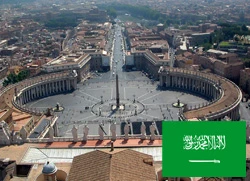
The most interesting story this week was the talks have commenced between the Vatican and the Saudi authorities to discuss the construction of a new church to cater for the millions of expatriate Christians resident in the Kingdom. This follows the inauguration of the first church in Qatar last Friday. Now, personally, I don't have anytime for the Vatican or the Saudi authorities. Both institutions are probably using the idea of church construction as a smokescreen to hide the the true purpose of their talks -  the final eradication of all women and free-thinking men.

However, the Saudi-Vatican talks do raise a very interesting question - is it legal to build a church in the Arabian peninsula? This is an issue that has caused a great deal of debate on Islamic online forums. Traditionally, opponents of church building - including the Saudi government and senior clerics - have quoted the following hadith: "No two religions (deens) will come together in the Arabian peninsula..." (Malik's Muwatta) to justify their opposition to any churches being built in the Arabian peninsula. Reflecting this position, Lahdan bin Issa al-Muhanadi - columnist with the Doha daily al-Arab - wrote "The cross should not be raised in the sky of Qatar, nor should bells toll in Doha." (This reminds me of an amusing story. When the construction of the Burj al-Arab hotel was completed in Dubai, the locals were annoyed to discover that while the hotel may look like a sail from the mainland, from out at sea it looks like a giant crucifix!). Classical legal scholars - like Ahmad ibn Naqib al-Misri - argued that non-Muslim subjects of Muslim lands are forbidden from building new churches [Reliance of the Traveller: o11.5(7)]. Opposition to church building also reflects wider opposition to the presence of non-Muslims in the Arabian peninsula - often based on problematic hadith like the following: "O I indeed will exile the Jews and the Christians from the Arabian Peninsula until I leave no one but a Muslim." (Sahih Muslim) 

It is essential that hadith are seen in their proper historical context, and are not used to justify the persecution and expulsion of non-Muslims from the Arabian peninsula. Wide and simplistic interpretations of the above mentioned hadith are not supported by all scholars. Abdul Hamid al-Ansari - former Dean of the Shari'ah School at Qatar University - in a local article argues that:

"This does not mean that churches should be banned in Qatar because religious scholars believe it applies to the Hijaz - specifically Mecca and Medina. Let's all welcome the presence of churches in Qatar... as a demonstration of Islamic tolerance and human brotherhood. When the spiritual needs of people are met, they will be more happy at work. This new building is a delight for our hearts."

This position is supported by a number of fatwas which advocate freedom of religion and protecting non-Islamic places of worship. Therefore, the majority position is that building churches in Saudi is perfectly legal - as long as they are not built within the confines of the cities of Mecca and Medina. This still leaves two important questions to be answered. 

Firstly, in the absence of churches, can non-Muslims pray in a mosque? There is an interesting report that tells of a Christian delegation of Najraan calling on the Prophet. After 'Asr prayer, the Christians performed their prayers at the Prophet's mosque. As the Ka'bah was declared the Muslims' qiblah, the delegation prayed facing southwards. In other words the Prophet allowed Christians to pray in his mosque facing their own qiblah

Secondly, can Muslims pray in a church? The conditions under which a Muslim can pray in a church are set out in the following fatwa. Essentially, if there is an alternative mosque to pray in then a Muslim is not allowed to pray in the church. But, if he is traveling and there is no alternative he may pray in a church. However, he must take care not to be distracted by the idols and Christian symbols within the church, or to upset those Christians worshipping in the church.

Anyway, enough for now.